[Claude Fable 5.1 launched 1 September 2026](https://www.anthropic.com/claude-fable-and-mythos-5-1), generally available today in Claude.ai, Claude Code, Claude Cowork, the API (claude-fable-5-1), Amazon Bedrock, Google Vertex AI, and Microsoft Azure Foundry. It keeps Fable 5's 1-million-token context window and 128K max output, cuts cache-read pricing 75% (from $1.00 to $0.25 per million tokens), and adds five selectable effort levels (Low, Medium, High, XHigh, Max) that trade cost and latency for reasoning depth.
Claude Mythos 5.1 is the same underlying model with reduced safety guardrails for narrow, vetted use: defensive cybersecurity work (Cyber Verification Program) and life-sciences R&D (Life Sciences Verification Program, US organizations only for now). It is not publicly available.
The context most coverage skips: Fable 5, the model 5.1 replaces, launched 9 June 2026 and was suspended globally by US Commerce Department export-control order just three days later, after Amazon researchers demonstrated a jailbreak that surfaced known minor vulnerabilities. The suspension lasted 19 days. Anthropic redeployed it 1 July with a new safety classifier. Fable 5.1 supersedes that patched version entirely.
Pricing is unchanged from Fable 5: $10 per million input tokens, $50 per million output tokens. The savings are in caching and effort tuning, not the base rate.
Five tiers, and where Fable actually sits
Anthropic's current lineup runs Haiku, Sonnet, Opus, Fable, and Mythos, in ascending order of capability and cost. Fable isn't a rename of Opus, and the two remain separate, concurrently available tiers: Opus 5 is still Anthropic's general-purpose flagship, while Fable is pitched specifically at coding, agentic research, and long-document work, with Mythos as a further, safety-gated tier above it for narrow defensive-security and life-sciences use. The naming is genuinely confusing on first encounter, and it shows up in search behavior: queries like "is fable 5 back," "fable 5 banned," and "when is fable 5 coming back" have been running since June, most of them almost certainly landing on stale news about the ban rather than the fact that Fable 5.1 has already superseded it.
What actually changed in 5.1
Benchmark                          Fable 5    Fable 5.1   Opus 5
----------------------------------------------------------------
Terminal-Bench-Science 0.1          24.7%       52.6%       29.0%
Terminal-Bench 4.0 (agentic coding) 42.0%       55.8%       52.3%
CursorBench 3.2.0 (coding)          70.5%       73.4%       70.0%
Humanity's Last Exam (no tools)     57.8%       60.9%       56.6%
OSWorld 2.0 (strict)                36.1%       41.7%       39.6%
AutomationBench                     17.1%       31.4%       26.9%

Source: Anthropic's own published benchmarks, September 2026.
Vendor-reported numbers, not independently reproduced - treat the
gap over Opus 5 as directional, not a guaranteed real-task margin.
The biggest jump is Terminal-Bench-Science, a benchmark for multistep agentic research: Fable 5.1 more than doubles Fable 5's score and pulls well ahead of Opus 5. Anthropic attributes this to improved reasoning across the full 1M-token context window and better multistep follow-through on a model's own intermediate findings, plus stronger vision handling for dense tables and charts buried inside long PDFs. Two features are new rather than incremental. Effort levels (Low, Medium, High, XHigh, Max) let you dial how hard the model works on a given step; indie reviewer Simon Willison ran his standard pelican-on-a-bicycle SVG test across the tiers and found Max effort produced his best result yet from any model, at a cost of $3.30 and roughly 14 minutes for a single test task, illustrating just how far Max effort pushes latency and spend for marginal quality gains. Content provenance tracking embeds an invisible, cryptographic watermark in Fable 5.1's output, checkable through a separate detection API, as part of Anthropic's compliance with the EU AI Act's provenance requirements for models released after 2 August 2026. The watermark carries no user, organization, or conversation data. Reaction to it has been mixed: MacRumors' comment section produced blunt pushback ("the watermark is a hard pass for me"), reflecting a broader discomfort with output-tagging even when it's privacy-preserving by design.
The ban, the 19 days, and the redeploy
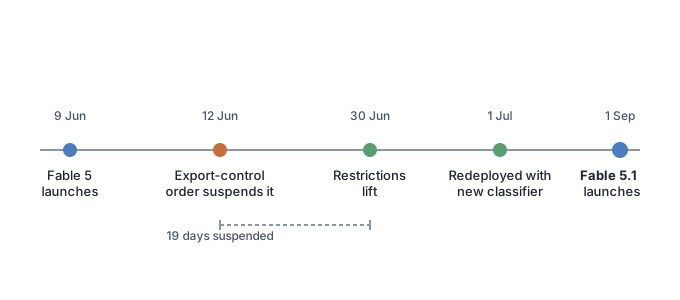
Fable 5 and Mythos 5 launched 9 June 2026. Three days later, at 5:21pm ET on 12 June, the US Commerce Department ordered Anthropic to suspend both models for foreign nationals, after Amazon researchers showed that a jailbreak-style prompting technique could get Fable 5 to surface a small number of previously known, minor vulnerabilities. Because Anthropic said it had no reliable real-time way to verify a user's nationality, the suspension applied globally, to every user, not just the foreign nationals the order targeted. Anthropic pushed back publicly, noting the same jailbreak demo was reproducible on Haiku 4.5, Sonnet 4.6, Opus 4.6 through 4.8, GPT-5.4, GPT-5.5, and Kimi K2.7, meaning the underlying issue wasn't unique to Fable 5 at all.
The suspension lasted 19 days. Export restrictions lifted on 30 June after what Anthropic described as productive conversations with the government, and the models were redeployed 1 July with a new classifier that Anthropic says blocks the specific bypass technique in over 99% of cases, rerouting flagged requests to Opus 4.8 instead. Cloud-platform access (AWS, GCP, Azure) was restored on a rolling basis after that. None of this is secret, Anthropic documented it in two of its own posts, and outlets including TechCrunch and NBC News covered it in real time. But the connective tissue between that June story and today's 5.1 launch is largely missing from this week's coverage: VentureBeat, TechCrunch, and MacRumors don't mention the ban in their 5.1 launch coverage at all; tech-ish.com does recap the June ban and July redeploy, but as background on Fable 5, not tied forward to what it means for anyone still searching for an update today. If you're one of the people still searching "is Fable 5 back," the honest answer is that the redeployed version has already been retired in favor of 5.1, which launched with none of the restrictions the June order imposed.
Pricing, side by side
                     Fable 5              Fable 5.1
------------------------------------------------------------
Input tokens         $10 / million         $10 / million
Output tokens         $50 / million         $50 / million
Cache reads            $1.00 / million       $0.25 / million
Typical workload       baseline              ~25% cheaper
Agentic tasks           baseline              up to ~45% cheaper

Context window: 1M tokens in, 128K tokens out - unchanged.
Mythos 5.1 pricing is not public; access is gated to vetted
Cyber Verification Program and Life Sciences Verification
Program participants, US organizations only for the latter
as of this launch.
Does the bigger context window actually help document research?
Fable 5.1 keeps the same 1M-token window as Fable 5, and Anthropic's specific claim for 5.1 is improved reasoning *across* that window, not a bigger one. Worth knowing before you lean on it for a big research pass: an independent deep-dive on the Fable-class 1M window (run against Fable 5, not yet re-verified against 5.1) found Claude's tokenizer runs roughly 30% denser than older Claude models, so the practically usable budget inside Claude Code is closer to 830K tokens once auto-compaction overhead is accounted for, with retrieval reliability measurably degrading past roughly 400K tokens and becoming unreliable beyond 600K. None of that is a defect specific to 5.1, it's a known shape of how long-context models behave under real use, and Anthropic's improved-reasoning claim for 5.1 may move that curve; there just isn't independent 5.1-specific data yet to confirm by how much.
For readers who also use Gemini Notebook (formerly NotebookLM) for research, the practical split hasn't changed with this release: Gemini Notebook stays the better tool when you need every answer traceable to a specific, citable source inside a fixed set of documents you chose, which is the whole point of its citation-locked design. A full-context model like Fable 5.1 is the stronger option for open-ended synthesis across a large, static set of documents, finding a contradiction between two contracts, or connecting an argument that spans a dozen papers, where the useful signal lives *between* documents rather than inside any single one. If your workflow is genuinely one or the other, this launch doesn't change which tool fits; if you do both, the new effort levels give you a cheaper Low or Medium setting for routine document loading instead of paying full Max-effort rates for something that doesn't need deep reasoning.
How people are actually reacting
Reaction on Hacker News has been more skeptical than celebratory. One Anthropic engineer highlighted the doubled Terminal-Bench-Science score and a genuine writing-quality improvement, but the dominant thread is a running complaint about Claude's output generally: commenters describe dense, corporate-toned "slop" and speculate, without confirmation, that verbosity is incentivized by token-based billing. Several say they've moved workloads to GPT-5.6 ("Sol") or Codex over readability and cost, a comparison this launch didn't settle in Anthropic's favor for at least part of its user base. Simon Willison's pelican benchmark, meanwhile, noted Fable 5.1's Max-effort output lacked the visual "flair" he got from Gemini 3.7 Flash on the same prompt, one of the only direct head-to-head reactions from this launch cycle. None of this is a verdict on the model's real capability, benchmark gains and subjective writing-style complaints are different axes entirely, but it's a more mixed reception than Anthropic's own announcement conveys.
People also ask
What's the difference between Claude Fable 5.1 and Mythos 5.1?
They're the same underlying model with different safety tuning. Fable 5.1 is generally available and will find security vulnerabilities defensively but won't write exploits (those requests route to Opus). Mythos 5.1 loosens those cyber and life-sciences safeguards specifically for vetted participants in Anthropic's Cyber Verification Program and Life Sciences Verification Program, and isn't available to the public.
Why was Claude Fable 5 banned?
It wasn't banned outright. The US Commerce Department ordered a suspension for foreign nationals on 12 June 2026, three days after launch, after Amazon researchers demonstrated a jailbreak that surfaced known, minor vulnerabilities. Anthropic suspended the model globally because it had no reliable way to verify user nationality in real time. The suspension lasted 19 days and lifted on 30 June.
Is Fable 5 still available?
No. Fable 5.1, launched 1 September 2026, supersedes the redeployed Fable 5 entirely across Claude.ai, Claude Code, Claude Cowork, and the API.
How much does Claude Fable 5.1 cost?
$10 per million input tokens and $50 per million output tokens, unchanged from Fable 5. Cache-read pricing dropped 75%, from $1.00 to $0.25 per million tokens, cutting typical workload costs by roughly 25% and heavily agentic workloads by up to 45%.
What is Claude Fable 5.1's context window?
1 million tokens of input, 128,000 tokens of output, the same as Fable 5. Anthropic's claim for 5.1 is improved reasoning across that window, not a larger one.
Does Claude Fable 5.1 have a watermark?
Yes. It embeds an invisible content-provenance watermark, checkable through a separate detection API, as part of Anthropic's EU AI Act compliance for models released after 2 August 2026. It doesn't contain user, organization, or conversation data.