Qwen3.8 Max scores higher on Artificial Analysis's Intelligence Index (45 vs. 36) but costs roughly 70% more and generates output at under half DeepSeek's speed (42 vs. 99 tokens/second), per Artificial Analysis's current head-to-head, checked today.
DeepSeek V4 Pro's weights are MIT-licensed and downloadable. Qwen3.8 Max's hosted API is proprietary, and even the separately released open-weight checkpoint behind it carries a custom, non-Apache license with a commercial-revenue trigger, not the permissive license Qwen's smaller models are known for.
On agentic coding and terminal use, DeepSeek is competitive or ahead: it edges Qwen on SciCode and loses badly on Terminal-Bench 4.0 (14% vs. 39%). Qwen leads general knowledge and agentic-knowledge-work benchmarks by a wide margin.
DeepSeek has a built-in off-peak discount, roughly 50% cheaper input and output, that applies by default to most of the week; the full price only kicks in during two narrow weekday UTC blocks. Qwen's pricing is flat around the clock.
The flagships, as of October 2026
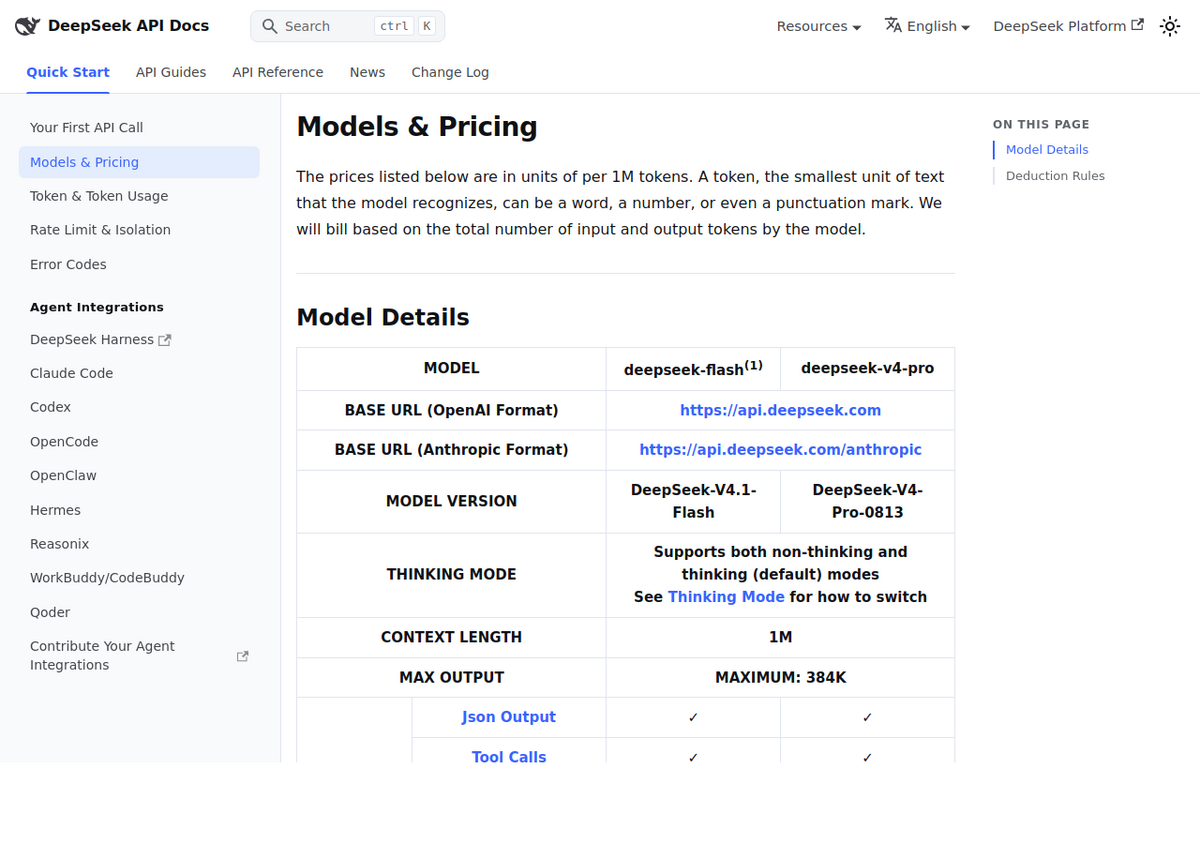
Both companies ship under version numbers that change often enough to confuse search results, so it's worth being precise about which build this comparison covers. DeepSeek-V4-Pro-0813 is the general-availability release DeepSeek's own API docs list today, dated by its version suffix to 13 August 2026; it followed an April 2026 preview build that many older comparison pages (including some still-ranking ones) are actually measuring instead. Per NVIDIA's NIM model card, it's a mixture-of-experts model with 1.6 trillion total parameters and 49 billion active per token, 384 routed experts with 6 selected per token, a 1-million-token context window, and a 384,000-token maximum output. One secondary source lists the GA card at 1.7 trillion total instead of 1.6 trillion; we could not confirm that discrepancy against DeepSeek's own technical report and flag it here rather than picking a number to sound more precise than the evidence supports.
Qwen3.8-Max-0902 is Alibaba's current flagship, a September 2026 refresh of the Qwen3.8-Max line that first launched 3 August 2026. It's a sparse mixture-of-experts model reported at 2.4 trillion total parameters with roughly 95 billion active per token (512 experts, 10 selected per token, per multiple independent trackers; Alibaba's own pages don't publish the expert count directly). Artificial Analysis lists its context window at 984,000 tokens, essentially the same practical 1M-token class as DeepSeek, extended from a smaller native window. Unlike DeepSeek, Qwen3.8 Max also accepts image input through the hosted API; DeepSeek V4 Pro is text-only.
Pricing: official numbers, not aggregator guesses
DeepSeek publishes pricing directly on its own API docs, split by whether you hit it during off-peak or peak UTC hours. Alibaba publishes Qwen3.8-Max pricing on its own Model Studio pricing page, in CNY, tiered by deployment region: China/global-default pricing is noticeably cheaper than the Singapore/US international deployment most non-China developers will actually use.
Per 1M tokens              DeepSeek V4 Pro-0813      Qwen3.8 Max-0902
-----------------------------------------------------------------------
Input (peak hours)          $1.32                      $2.00
Input (off-peak, DeepSeek   $0.66                      n/a (flat rate)
  only, see note below)
Output (peak hours)         $3.96                      $6.00
Output (off-peak)           $1.98                      n/a
Cache hit                   $0.044                     $0.25
Blended (AA's 7:2:1 ratio)  $0.69                       $1.18

DeepSeek peak window (full price): 01:00-04:00 and 06:00-10:00 UTC,
Monday through Friday, excluding Chinese public holidays. Every other
hour, including weekends, bills at the cheaper off-peak rate. Source:
DeepSeek's own API docs, api-docs.deepseek.com/quick_start/pricing.
Qwen figures are the Singapore/US international deployment tier, converted
from Alibaba's own CNY 14.988 / CNY 44.965 per-million rate (Alibaba's
China/global-default tier is roughly 20% cheaper at CNY 12 / CNY 36).
Source: help.aliyun.com/en/model-studio/model-pricing, checked 14 Oct 2026.
There's also a budget tier on each side worth knowing about if the flagship price is more than you need: DeepSeek's deepseek-flash (DeepSeek-V4.1-Flash) runs $0.15/$0.6 at peak hours and $0.075/$0.3 off-peak per million input/output tokens, roughly a ninth of the flagship's cost, with the same 1M context window. Alibaba's legacy qwen-max alias is similarly priced down on its China/global-default tier at CNY 2.4/9.6 per million tokens, a fifth of Qwen3.8 Max's own China-tier CNY 12/36, but it's a non-thinking-only model with no tiered pricing by context length, an easy model string to grab by mistake if you're copying an old integration guide.
Benchmarks: where each one actually wins
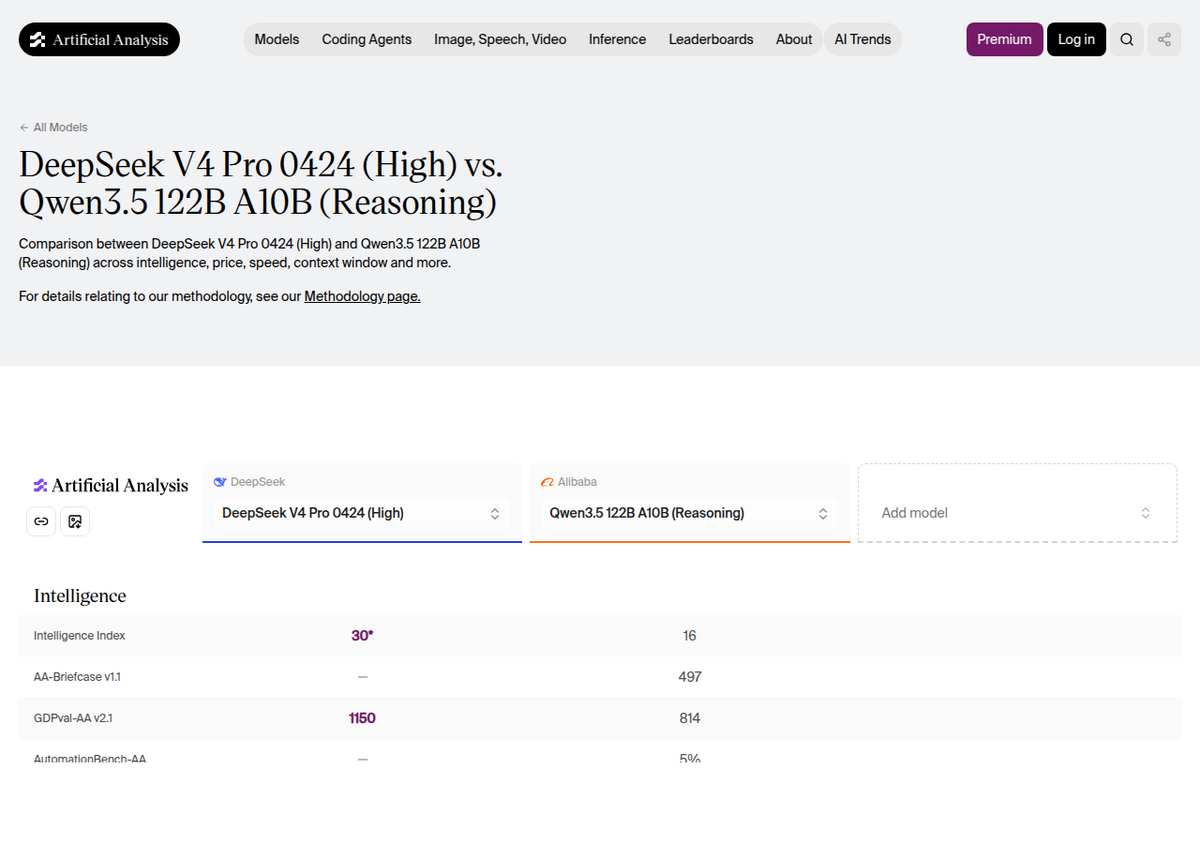
Artificial Analysis runs a direct head-to-head between the current flagships, both set to maximum reasoning effort, scored on its Intelligence Index v4.3.2. Qwen3.8 Max leads on overall intelligence and on most agentic-knowledge-work tasks; DeepSeek V4 Pro is close or ahead on coding-adjacent benchmarks and dramatically cheaper and faster everywhere.
Benchmark (max effort)                 Qwen3.8 Max-0902    DeepSeek V4 Pro-0813
---------------------------------------------------------------------------
Intelligence Index (v4.3.2)             45                   36
Terminal-Bench 4.0 (agentic terminal)   39%                  14%
SciCode (coding)                        52%                  51%
AA-Briefcase v1.1 (agentic knowledge)   1617                 1257
GDPval-AA v2.1 (agentic real work)      1667                 1449
AutomationBench-AA (agentic SaaS)       56%                  57%
Humanity's Last Exam                    43%                  41%
GDP.pdf                                 23%                  11%
CritPt (physics reasoning)              18%                  18%
AA-Omniscience                          12                   1
AA-LCR v1.1 (long-context reasoning)    80%                  80%
Output speed (tokens/sec)               42                   99

Source: artificialanalysis.ai/models/comparisons/deepseek-v4-pro-vs-qwen3-8-max,
checked 14 Oct 2026. Note: Artificial Analysis publishes several versions of
this comparison at different DeepSeek reasoning-effort settings (High vs.
Max); scores shift by several points between them, so if you see different
numbers elsewhere, check which effort setting the page is showing.
The pattern that holds across both tables: Qwen wins on tasks that reward broad knowledge and multi-step agentic planning (Terminal-Bench, AA-Briefcase, GDPval-AA, AA-Omniscience), while the two are essentially tied on raw coding (SciCode) and long-context retrieval (AA-LCR, both at 80%). Neither model publishes a math-specific benchmark on this comparison. If your workload is closer to "write and debug code" than "plan and execute a multi-step agentic task," the benchmark gap matters a lot less than the 70% price difference.
Licensing: the gap most comparisons get wrong
DeepSeek V4 Pro's weights are reported as MIT-licensed, consistent with DeepSeek's prior V3 and R1 releases, per its NVIDIA NIM listing and independent model trackers (we could not pull the license file directly from DeepSeek's own Hugging Face repo to confirm the exact text, so treat this as strongly sourced but not primary-verified). MIT is about as permissive as licensing gets: commercial use, modification, and redistribution with no revenue cap.
Qwen3.8 Max is a different story, and it's where a lot of "Qwen is open source" coverage overstates things. The hosted API model is proprietary, full stop, same as Gemini or GPT. Alibaba did separately publish an open-weight checkpoint behind it, reportedly named Qwen3.8-2.4T-A95B, to Hugging Face around 12 August 2026, text-only and locked to thinking mode (the vision input and non-thinking mode that the hosted API offers aren't in the open release). But that checkpoint ships under a custom "Qwen3.8-Max license," not Apache 2.0, and multiple trackers report it includes a commercial-use carve-out requiring a separate agreement once a deploying company's trailing 12-month revenue exceeds $50 million in certain AI-service categories. That's a materially different deal than Qwen's smaller Qwen3.8-27B dense model, which is Apache 2.0, no revenue threshold. We weren't able to pull the exact license text to quote its terms verbatim, so verify the current license file on Hugging Face directly before you build a production dependency on it. The practical takeaway: "Qwen is open-weight" is true for Qwen's smaller models and false, or at least heavily qualified, for its actual 2.4-trillion-parameter flagship.
Where you can actually run them
- Both vendors offer direct API access: api.deepseek.com (OpenAI- and Anthropic-compatible endpoints) and Alibaba Cloud Model Studio for Qwen, billed as shown above.
- AWS added DeepSeek-V3.1 and several Qwen3 models to Bedrock as fully managed offerings in 2025 (per Amazon's own announcement): DeepSeek-V3.1 and Qwen3-Coder-480B in US East (Ohio) and AP (Jakarta), with Qwen3-32B, Qwen3-235B and Qwen3-Coder-30B also reaching EU (Frankfurt). Check Bedrock's current catalog for whether V4 Pro and Qwen3.8 Max specifically have landed there, since Bedrock additions lag new releases.
- DeepSeek V4 Pro's MIT license makes self-hosting straightforward legally, though it needs real infrastructure. DeepSeek's prior V3/R1 generation, built on a similar architecture, needs roughly 16 H100 GPUs to run at its native FP8 precision, per NVIDIA's own deployment documentation; 8-GPU setups are possible only with quantization that costs some accuracy. V4 Pro's footprint is in the same range. The open Qwen checkpoint can also be self-hosted, subject to the revenue-threshold license terms above.
- DeepSeek's and Alibaba's primary infrastructure is China-based, though both offer international API endpoints (DeepSeek's default api.deepseek.com, Alibaba's Singapore/US Model Studio deployments). Alibaba's own pricing page lists a dedicated, higher-priced "US deployment" tier, which implies real regional routing rather than a single global endpoint. If data residency or added latency to China-based infrastructure is a compliance concern for your organization, check it directly with either vendor rather than assuming a default.
Which should you actually pick
If cost per token and raw throughput matter most, or your workload leans toward coding, DeepSeek V4 Pro is the clear pick: cheaper at every tier, more than twice as fast, MIT-licensed if you ever want to self-host, and competitive on SciCode. Since DeepSeek's discounted rate already applies by default outside two narrow weekday blocks, a batch workload (document processing, overnight pipelines) only needs to avoid those specific hours to run at half price. For our audience specifically, that price-per-token advantage matters most in long-document, high-volume research workflows, running a large batch of papers or transcripts through a 1M-context model, where Qwen's 70% premium adds up fast across thousands of calls.
If you need the highest score on broad agentic and knowledge-work benchmarks, want native image input in the same model, and the licensing difference doesn't affect you because you're calling the hosted API either way, Qwen3.8 Max is ahead on the numbers that matter for complex multi-step tasks (Terminal-Bench, AA-Briefcase, GDPval-AA). The gap is real but it isn't free: you're paying roughly 70% more and getting output at under half the speed for it.
What trips people up
- The old qwen-max alias still resolves, costs a fifth of the flagship price, and silently runs a weaker non-thinking-only model with no tiered pricing. If you copied an integration snippet from an older guide, check the exact model string before assuming you're paying flagship rates.
- A surprising number of still-ranking comparison pages benchmark DeepSeek-V4-Pro-0424, the April preview, against Qwen3.8 Max, the current flagship, which skews the comparison in Qwen's favor on both price and intelligence score since the preview build was never the shipped product. Check that any comparison you're reading uses the August 0813 GA release.
- The same model pairing scores differently on Artificial Analysis's "High" vs. "Max" effort pages. Always check which version of the comparison you're looking at before quoting a specific number.
- Qwen3.8 Max's open-weight checkpoint doesn't match the hosted API: no vision input, no non-thinking mode, and a different license than Qwen's smaller Apache 2.0 models.
People also ask
Is DeepSeek or Qwen better for coding?
They're close on raw coding (SciCode: DeepSeek 51% vs. Qwen 52%), but DeepSeek V4 Pro is far behind on agentic terminal use (Terminal-Bench 4.0: 14% vs. Qwen's 39%). For straightforward code generation either works; for agentic coding tasks that involve planning and executing multi-step terminal actions, Qwen3.8 Max currently scores much higher.
Is DeepSeek cheaper than Qwen?
Yes, at every tier checked. DeepSeek V4 Pro's peak-hours rate is $1.32/$3.96 per million input/output tokens versus Qwen3.8 Max's flat $2.00/$6.00, and DeepSeek drops to $0.66/$1.98 off-peak, which is the default for most of the week except two narrow weekday UTC blocks. Qwen's pricing never changes by time of day.
Is DeepSeek V4 Pro open source?
Its weights are reported as MIT-licensed, DeepSeek's standard license for prior releases like V3 and R1, which permits commercial use and self-hosting with no revenue restriction. We couldn't independently verify the exact license file from DeepSeek's own repository, so check it directly before depending on it for a production deployment.
Is Qwen3.8 Max open weight?
Partially, and with caveats most coverage misses. The hosted API model is proprietary. Alibaba separately published an open-weight checkpoint behind it in August 2026, but under a custom "Qwen3.8-Max license," not the permissive Apache 2.0 license used by Qwen's smaller models, reportedly including a commercial-revenue threshold for large deployments.
Which has a longer context window, DeepSeek or Qwen?
They're essentially tied: DeepSeek V4 Pro lists a 1,000,000-token context window, Qwen3.8 Max lists 984,000, both per Artificial Analysis's current comparison. Both are extended from smaller native windows, not natively that large.
Can I self-host DeepSeek or Qwen instead of using the API?
Both are technically possible. DeepSeek V4 Pro's MIT license makes self-hosting straightforward legally, though the 1.6-trillion-parameter model needs serious multi-GPU infrastructure. Qwen's open-weight checkpoint can also be self-hosted, but its custom license's commercial-revenue threshold is worth checking against your organization's scale before committing.